

When you walk into a showroom or search for sectional sofas online, there's a lot to see, and everything looks oh-so-good. You'll come across terms like L-sectionals, sectionals with a chaise, modular sectionals, left-arm facing, and so much more.
So let's quickly dive into the details of it all. What is a sectional couch, and which type or design will fit your space best?
We'll give you a detailed breakdown of the most common layouts and everything you need to know about sectionals so you can upgrade your spaces with confidence.
Let's get started!
What Is a Sectional Couch, Exactly?
A sectional couch, which some people call a sectional sofa, is a seating system made up of two or more individual parts that connect to form one piece of furniture. Unlike a traditional sofa, which has a single fixed frame, a sectional has separate parts.
The biggest advantage of this design is flexibility. You'll find some sectionals that come in a fixed layout of two sofas, while others are modular, allowing you to rearrange or expand them as you please.
Most sectional sofas maximize seating without the need for several separate pieces of furniture. This is why they're popular in family rooms, open-plan homes, apartments, and entertainment spaces.
Parts of a Sectional Couch
Reading about the parts is one thing, but seeing them on a real sofa makes them much easier to understand.

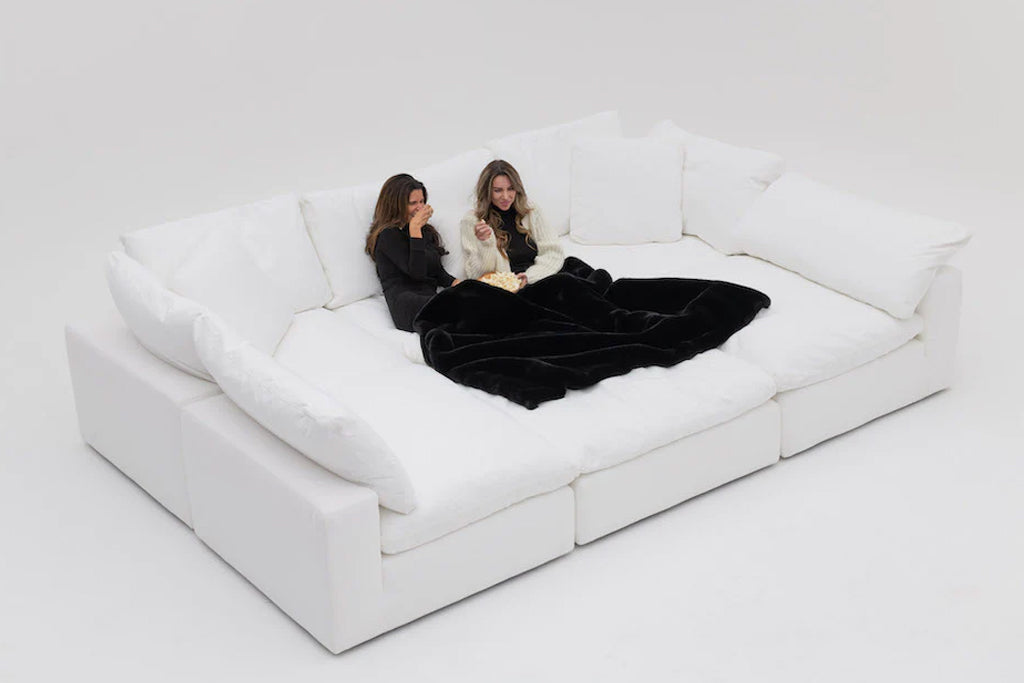
The Soulfa 6-Cube Large Sectional (Movie Pit) shows how several individual pieces come together to create one spacious seating arrangement.
In the 6-Cube Large Sectional above, you'll notice what looks like one large sofa is actually made up of several individual pieces or modules. Together these pieces create the spacious, modular sectional sofa you see here.
The Chaise
The extended section on the left is the chaise, and it gives you plenty of room to stretch your legs and lounge.
Shopping Tip: When shopping, keep in mind that a left-facing chaise means the extension is on your left when you’re standing and looking directly at the sofa, as in the above sectional.
Corner Cube

The inside corner of the sectional, where the left part and right meet, is filled by a corner cube. This is a piece that joins the chaise extension to the other section to form the L shape. Without a corner cube, what you will have are two separate sofas rather than one continuous seating arrangement.
This cube is also what allows a sectional to use space in corners efficiently.
Armless Cube

You'll notice that the two pieces with backrests on the left, and the one after the corner cube on the right, don't have side arms. These are called armless cubes, and they help to create a continuous seating area.
And if you're creating a custom sofa, you can add as many armless cubes as your space will comfortably allow. It's easy to create a layout that fits your room instead of settling for a standard size.
Corner Cube (One-Arm End Piece)

The corner cube is the only module with two functions. It can be used as the left or right end piece of a straight sofa or loveseat, creating a clean, finished look while providing comfortable arm support. It can also be used as the corner module in an L-shaped sectional, allowing the sofa to change direction seamlessly.
In most modular cloud couch designs, corner cubes frame the layout while armless cubes fill the space between, making it easy to expand, rearrange, or customize the configuration as your space and needs evolve.
These end pieces complete the overall design of the sectional sofa, and frame the other modules in the middle.
Ottoman

Some sectional couches will include an ottoman cube. In the one above, the ottoman is placed in front of the chaise, creating an even longer extension for lounging or simply, just extra seating space.
An ottoman is the most versatile piece in a sectional sofa. You can place one or two in front of the chaise, use it as a coffee table by placing a tray on it, or move it around whenever you need to because it's separate from the main sofa and is meant to float where needed.
Quick Note: Right-Arm Facing vs. Left-Arm Facing
If you're looking at an image or standing right in front of a sofa, right-arm facing means the arm is on your right. Left-arm facing means the arm is on your left.
The position of the arm will determine which direction the chaise or the open side of the sectional will extend once it's in your space.
Why Does This Matter?
Imagine bringing a perfect 4-Cube Ottoman Chaise Sectional home only to realize that the chaise blocks your kitchen and doesn't face the TV. Choosing the wrong orientation can make the room feel awkward. Unless, of course, you have modular cubes that can easily be reoriented, like in the case of the Soulfa modular couch.
The Main Types of Sectional Sofas
There are four main layouts for sectionals. The best will depend on the size of your space, how many people use it regularly, and whether you expect your seating needs to change over time.
Modular Sectional Sofas

Modular sectional couches are made up of individual modules (also called cubes or simply pieces) that connect together to form one single piece of furniture. Unlike fixed sectionals with two large pieces, you have the flexibility to add or remove pieces as your seating needs evolve.
For instance, you can add more armless cubes to expand your sectional from a 6-cube to an 8-cube, or even reduce it to a 5-cube modular sectional couch, and create an entirely new layout.
L-Shaped Sectional Couches
This is one of the most common configurations for sectionals, where two fully built parts or one-armed sofas meet at a right angle to create a comfortable corner layout.
L-shaped sectionals can also be modular. Rather than the two one-armed sofas, they can be made of individual cubes, with corner cubes (one-arm end cubes) on either side.

This 5-Cube Corner L-Sectional is modular in style, made from two corner cubes (one-arm end pieces), two armless cubes, and another corner cube in the actual corner of the sectional.
Choosing between a modular L-sectional and the traditional L-sectional (or two sofas) comes down to the flexibility you need. Unlike the two fixed frames, you can reconfigure your modular sectional by adding or removing modules.
U-Shaped and Pit Sectionals

As the letter suggests, a U-shaped sectional is made in the form of a U. It surrounds a central space with seating on three sides, creating room in the middle. This layout ensures everyone seats facing each other, instead of sitting in a long row.
Pit sectionals evolve from this idea. Instead of leaving the space in the middle empty or adding a coffee table, place an ottoman cube to create a spacious seating and lounging platform.
Soulfa's 6-Cube Iconic Movie Pit Sectional Sofa is a good example of this layout. It’s made up of six cubes, washable, non-toxic fabrics, deep cushions with a cloud-like feel, and the scale of a luxury lounge.
Sectional Couch
Designing your sectional couch sanctuary starts here
Shop NowStyling Tip: As shown below, you can rearrange the above movie pit sectional into a 6-cube large sectional sofa with a chaise when you want to.
Chaise Sectional
A chaise sectional is like a full L-shaped sectional but with one side fully extended for stretching out your legs. For many first-time buyers, this type of sectional sofa offers the benefits of comfort without needing a dramatic room redesign.
Choosing Between a Sectional Couch vs. Traditional Sofa
| Sectional Couch | Traditional Sofa | |
| Best For | Families, entertaining, movie nights, open-plan living | Smaller rooms, formal living spaces, flexible layouts |
| Seating Capacity | Seats more people in one connected arrangement | Usually seats 2–3 people, with additional seating needed |
| Layout | Available in L-shaped, U-shaped, chaise, and modular designs | Single, straight seating arrangement |
| Flexibility | Modular sectionals can be rearranged or expanded over time | Fixed design with limited reconfiguration |
| Space Requirements | Best for medium to large rooms, although compact options suit apartments | Works well in almost any room size |
| Moving Home | Modular sectionals are easier to move because they separate into individual pieces | Easier to move if it's a single sofa, but oversized models can be awkward |
| Comfort | Great for stretching out, lounging, and everyday relaxation | Better suited to upright seating and conversation |
| Future-Proofing | Modular designs can grow with your household by adding new sections | You'll usually need to replace the sofa if your seating needs change |
| Cost | Often a higher upfront investment, especially for larger layouts | Generally lower starting price, depending on size and materials |
Your decision will depend on how you use your space, how much seating you need, and whether you want flexibility now or later. A sectional sofa works well if you:
- Have a small or large household.
- Regularly host family or friends.
- Enjoy movie nights or watching TV together.
- Want to define the seating area in an open-concept living space.
- Prefer stretching out instead of sitting upright.
A standard sofa works well if you only want a fixed 2- or 3-seater structure. Depending on the available space, you can add accent chairs, a loveseat, or a second sofa for additional seating.
How to Choose the Right Sectional for Your Room
Once you've decided a sectional is the right direction, it's time to narrow down the options. The goal is to find one that fits your room, and one that will continue working for years as your home and lifestyle evolve.
Start by Measuring the Room and the Doorways
Start with the room itself. Measure:
- The wall where the sectional will sit.
- The available floor space.
- Walkways around the furniture.
Aim to leave at least 30 inches of clearance for walking wherever people need to move comfortably. This helps the room feel open instead of cramped.
Next, don't forget the delivery route. Measure:
- Front doors
- Hallways
- Staircases
- Elevators (if applicable)
One advantage of a multi-piece sectional is that you can carry each section separately. That makes delivery much easier.
Match the Shape of the Sectional to the Room
The shape you choose should support the way your room functions. Here's a simple guide:
| Room Type | Recommended Sectional |
| Small apartment | Compact chaise sectional |
| Narrow living room | L-shaped sectional |
| Square family room | L-shaped or modular sectional |
| Large open-concept room | U-shaped sectional |
| Growing household | Expandable modular sectional |
Don't assume a larger sectional is automatically better. A compact layout that leaves room to move often feels more comfortable than oversized furniture squeezed into a small space.
Likewise, don't overlook future changes. If you're planning to move, renovate, or expect your household to grow, a modular configuration can adapt without replacing the entire sofa.
Next, Look How Your Sectional Is Made
The upholstery may catch your eye first, but the materials underneath and how the sectional is made determine how it performs over the next decade. Pay attention to:
- Frame Material: Kiln-dried hardwood generally lasts much longer than particleboard or softwood.
- Foam Density: High-density foam keeps its shape and resists sagging with everyday use.
- Joinery: Well-built frames stay strong and don't loosen over time.
- Upholstery: Choose a fabric that suits your household, whether that's performance fabric for kids and pets or leather for easy wipe-clean maintenance.
If you're comparing brands, ask what's beneath the cushions rather than focusing only on the colors of fabrics.
Here at Soulfa, we handcraft each cube using kiln-dried hardwood, high-resilience foam, and non-toxic PFAS-free materials. Our legal 20-year warranty is a testament to our construction and our confidence in our furniture's capacity to last for decades without structural failure.
Explore our collection of modular couches for non-toxic, luxury sectionals.

Gut-Check Before You Buy
Ask yourself three questions:
- Is my room square, narrow, or open-concept? Your floor plan will determine what type of sectional sofa will fit better
- How do people actually use this room? If everyone gathers to watch TV, talk, or relax and lounge, that will dictate the layout of your sectional couch.
- Will people move through this space often? Think about walkways to hallways, doors, and other rooms before choosing a large seating arrangement.
Quick Note: What to Look For in a Furniture Warranty
A long warranty doesn't automatically mean better quality, but it should clearly explain what's covered.
Look for:
- Coverage for the frame, not just the fabric.
- Clear terms instead of vague "lifetime" promises.
- A furniture maker willing to stand behind its construction.
Soulfa's 20-year legal warranty is a good example of the kind of confidence you should expect from a well-built sectional. It's backed by durable construction rather than marketing language.
Remember the old saying: buy nice or buy twice. A quality sectional may cost more upfront, but it can save you from replacing sagging furniture just a few years later.
Frequently Asked Questions
What Is the Difference Between a Sectional and a Regular Sofa?
A regular sofa has one fixed frame and typically seats two or three people. A sectional couch is made from two or more connected pieces that form a larger seating arrangement. Depending on the design, a sectional can be L-shaped, U-shaped, or modular.
How Many Pieces Does a Sectional Couch Usually Have?
Most sectionals include between two and six pieces or more. A simple chaise sectional may consist of just a sofa section and a chaise, while a larger U-shaped sectional might include several armless chairs, corner pieces, and an ottoman. Modular systems are even more flexible because you can add new pieces over time or reconfigure anytime.
What Is a Chaise on a Sectional Couch?
A chaise is the extended section designed for stretching your legs out comfortably. Unlike a standard seat, it provides full leg support without needing a separate footrest. Depending on the layout, the chaise can be on the right or left side of the sectional.
What Is a Modular Sectional Sofa?
A modular sectional is made up of individual pieces that connect to one another but aren't permanently fixed. That means you can rearrange the layout, add new sections, or create different seating configurations as your home or family changes. It's a practical option if you move often or simply enjoy refreshing your living space.
How Do You Tell Right-Arm Facing From Left-Arm Facing?
Stand facing the sectional sofa:
- If the arm is on your right, it's right-arm facing (RAF).
- If the arm is on your left, it's left-arm facing (LAF).
This orientation determines which direction the chaise or open side extends once the sectional is placed in your room. It's an important detail to confirm before ordering.
Are Sectionals Good for Small Living Rooms or Apartments?
Yes, provided you choose the right configuration. A compact L-shaped or chaise sectional can actually use corner space more efficiently than a sofa paired with separate chairs. Oversized U-shaped or pit sectionals, however, can overwhelm a smaller room and reduce comfortable walking space.
How Much Space Does a Sectional Sofa Need?
Besides the footprint of the furniture itself, leave at least 30 inches of clearance around the sectional. You'll also need to measure doors, staircases, hallways, and elevators before delivery. Because sectionals arrive as separate pieces, they're often easier to move into apartments than one oversized sofa.
What Materials Are Sectional Couches Made From?
Most sectional couches are upholstered in fabric, performance fabric, microfiber, or leather. The upholstery is only part of the story. Also consider:
- Hardwood versus particleboard frames
- High-density versus low-density foam
- Tight-Weave fabrics for increased durability
- Seat cushion construction
A well-built hardwood frame with quality foam usually contributes more to long-term comfort than the upholstery alone.
Can You Add More Pieces to a Sectional Later?
If you choose a modular sectional, yes. Many modular sofa systems allow you to add armless chairs, corner pieces, or ottomans later, giving you the freedom to expand your seating without replacing the entire sofa. Traditional fixed L-shaped or U-shaped sectionals generally don't offer this flexibility.
How Long Should a Good Sectional Sofa Last?
A quality sectional built with kiln-dried hardwood and high-density foam can last well over 10 years with normal use. Lower-quality materials often begin to sag or loosen within 1-3 years. A clearly written structural warranty is another good indicator of how much confidence a furniture maker has in its product.
Conclusion
A sectional couch is simply a sofa built from multiple connected pieces, but that simple design opens up far more possibilities than a traditional sofa. Whether you choose an L-shaped sectional or a modular sectional that grows with your home, the best option depends on your space and how you like to relax.
Now that you understand terms like chaise, modular, and right-arm facing, shopping for a sectional becomes much less intimidating. You'll be able to compare layouts with confidence instead of guessing what the product descriptions mean.