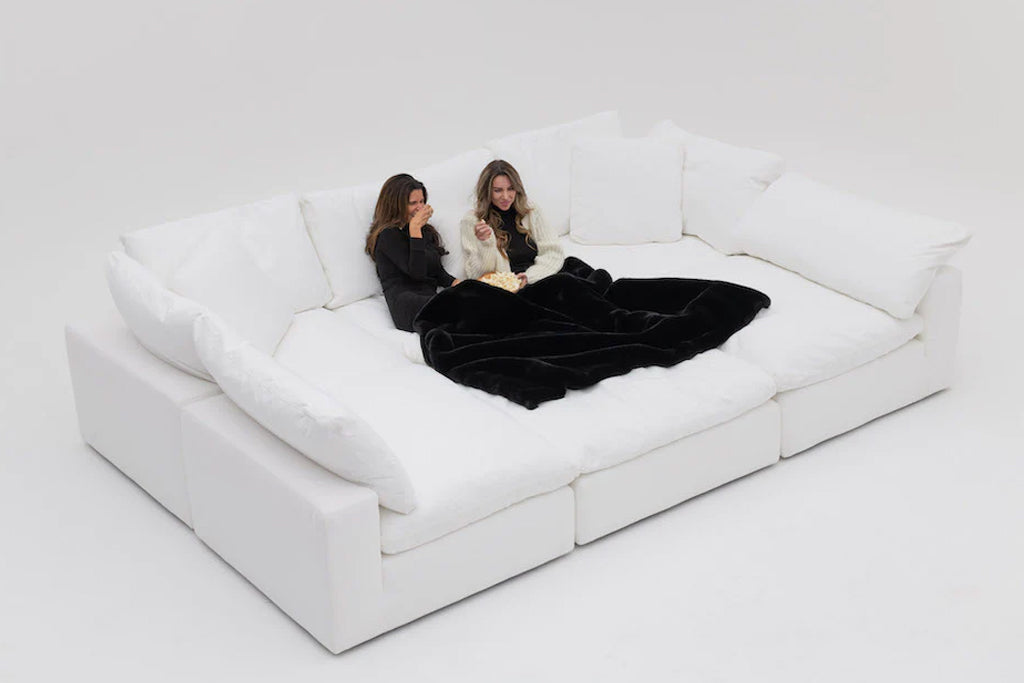

A Case Study in Rethinking the Luxury Furniture Business Model
Luxury furniture has long relied on a simple formula: premium location, curated showroom, elevated pricing. For decades, physical presence signaled credibility.
Soulfa rejected that model.
Not all at once, but deliberately.
From Los Angeles Warehouse to Nationwide Demand
In the beginning, Soulfa operated out of a makeshift showroom in an industrial area of Los Angeles, about an hour outside West Hollywood, California. It was not designed to impress. It was designed to function.
Appointments only. No foot traffic. No retail polish.
The goal was simple. Keep costs low, avoid unnecessary overhead, and focus on the product itself, then let the market respond. The company would either grow organically or fail, but if it succeeded, it would be because the customer made it win.
That philosophy extended to everything.
To minimize costs even further, the company did not accept credit cards. Payments were limited to cash, check, or peer-to-peer transfers. In a high-ticket category, that level of friction is unusual.
Everything was working against the model.
Customers had to trust the product, trust the process, and trust that delivery would actually happen. There was no large retail footprint reinforcing credibility. No traditional safety nets.
What happened next changed the trajectory of the company.
Word of mouth accelerated quickly. Early customers became advocates. Appointments filled.
Then something unexpected happened.
People started traveling.
Customers began flying in from Northern California, Nevada, Arizona, and even Texas just to see the product. What started as a local, appointment-only setup began to take on something closer to a following. Not driven by marketing, but by momentum. A kind of early, word-of-mouth cult dynamic built around the product itself.
At the same time, a different layer of demand emerged, including celebrities, influencers, professional athletes, and interior designers.
There was still no online checkout.
Sales happened through conversation.
Demand scaled anyway. In fact, it outpaced expectations by a wide margin. The company effectively built its reputation before building its infrastructure.
Once that trust was established, Soulfa made a shift. It launched online and expanded access beyond Los Angeles, opening up to customers across every state in the U.S. without adding physical retail.
The growth did not come from showrooms. It came from proof.
The Real Cost of a Showroom
Showrooms are not just a brand decision. They are a cost structure.
High-end retail space carries rent, staffing, inventory staging, and ongoing operational overhead. Those costs do not disappear. They get priced into the product.
That creates a tradeoff most brands do not openly address.
A showroom may help convert some buyers, but it also raises the price of the product, often by 15 to 25 percent. That increase filters out a different group of customers.
So the question is not whether you lose customers.
It is which customers you choose to lose.
Soulfa made a clear decision. It accepted that some buyers would walk away without a physical experience. In return, it avoided passing showroom costs into the product.
That decision reshaped the value proposition.
“From the beginning, we didn’t try to remove friction, we let it exist. If someone was still willing to buy after that, it meant they truly believed in the product. That kind of trust can’t be manufactured, it has to be earned.” - Vitória, CEO
Reallocating Value
This is not about eliminating cost. It is about reallocating it.
Instead of investing in retail environments, resources were directed toward product construction, materials, and logistics. The emphasis shifted from presentation to performance.
In traditional retail, part of what the customer pays for is the environment. In a direct-to-consumer model, that same capital can go into the product itself.
It is a different definition of luxury.
The Illusion of the Showroom Test
The core argument for showrooms has always been simple: customers need to feel the product.
But furniture does not reveal itself in five minutes.
Sitting on a couch in a showroom is not unlike trying on a pair of shoes. It may feel right in the moment, but that moment says very little about long-term comfort.
Real comfort is measured over time.
Materials break in. Support shifts. Daily use exposes what a short visit cannot. A couch that feels perfect in a controlled setting can feel entirely different after months of real living.
The showroom creates confidence, but not always accuracy.
The more relevant question is not how a couch feels today. It is how it feels a year from now.
“A showroom can sell a moment, but it can’t sell a year. We built the company around what happens after the purchase, not during it. That’s where the truth of the product actually lives.” - Vitória, CEO
Trust Has Shifted
Consumer behavior has evolved alongside technology.
AI-driven search, aggregated reviews, and long-form product comparisons have changed how people make decisions. Younger buyers, in particular, are increasingly comfortable making high-value purchases without ever stepping into a store.
A $10,000 purchase no longer requires a showroom visit. It requires information.
And in many cases, more information than a showroom can provide.
Instead of relying on a single interaction, customers now evaluate patterns. Consistency. Long-term feedback. Real-world use cases.
Trust is no longer built in a room. It is built over time, across data points.
Speed and Flexibility
Removing showrooms does more than reduce cost. It removes constraints.
Retail space locks a company into fixed locations, fixed layouts, and fixed overhead. It slows down adaptation.
Without those constraints, Soulfa operates with more flexibility. It can adjust inventory, refine product design, and scale without being tied to a physical footprint.
For a modular product, that flexibility matters.
A Different Customer Experience
Without a showroom, the experience changes.
It becomes less about a single visit and more about the ownership journey. Communication happens directly. Support is ongoing. The product proves itself over time.
The most important moment is not the purchase.
It is what happens after.
Not for Everyone
This model is not universal.
Showrooms still serve a purpose, especially for brands built around in-person experiences. For some customers, physical interaction will always matter.
But the absence of a showroom can work, if the product holds up and the trust is real.
Without that, the model fails quickly.
Conclusion
Soulfa did not start with a scalable retail strategy. It started with a warehouse in Los Angeles and a product that had to prove itself.
Everything about the early model made growth harder. Limited payment options. No website. No retail presence.
And yet, it worked.
The company took a calculated risk by not investing in showrooms. In doing so, it changed both its cost structure and its relationship with the customer.
In the long run, that decision did more than shape the business. It shifted where value was delivered.
Not into the store, but into the product.
And ultimately, that meant the customer did not just validate the brand.
They benefited from it.
“We didn’t scale because we had the best retail strategy. We scaled because people used the product, lived with it, and told someone else. In the end, the customer didn’t just validate the brand, they built Soulfa.” - Vitória, CEO