
You’ve probably heard terms like PFAS, VOCs, flame retardants, engineered wood, OEKO-TEX, and CertiPUR-US. It’s a lot to process. And when every brand claims to be “clean,” “green,” or “healthy,” it becomes even harder to tell what actually matters.
At Soulfa, we believe a truly non-toxic couch should meet a much higher standard than vague "clean" marketing claims.
In this guide, we pull back the upholstery and break down what actually makes a couch non-toxic, what to look for, and how to compare safety standards without getting lost in the noise. Let's get right into it!
What is a Non-Toxic Couch?
A non-toxic couch is rarely defined by a single badge or fabric claim. In reality, it's the result of safer choices across the entire production process.
Companies that focus on affordability or performance often rely on engineered wood held together by formaldehyde resins and polyurethane foam treated with a cocktail of flame retardants. Each of these plays a role in what the couch releases into your home over time. This is often referred to as off-gassing, where certain materials emit volatile organic compounds (VOCs) into the air.
That’s why terms like “PFAS-free,” “low VOC,” and “flame retardant free” matter, but are often misunderstood.
- PFAS-free speaks to stain and water-repellent chemistry
- Low VOC refers to reduced emissions and indoor air quality
- Flame-retardant-free refers to materials in foam, barriers, or construction
Each one focuses on a different part of the problem. At the same time, adhesives, finishes, foam, and composite wood all contribute to a couch’s overall emissions profile. Looking at one feature alone doesn’t give you the full picture.
Non-toxicity comes down to five key parts:
- Upholstery Fabric: Is it PFAS-free? Has it been tested for harmful substances?
- Cushion Core and Fills: Is the foam screened for problematic inputs? Are natural fills or safer hybrid options used? Do the pillows have synthetic foam?
- Frame Materials: Is the frame solid wood, or does it rely on engineered wood with higher formaldehyde concerns?
- Adhesives and Finishes: Are they low-VOC glues and clearly disclosed?
- Any Added Treatments: Was stain resistance engineered into the fabric, or sprayed on as a chemical coating? Are fire barriers or flame retardants added?
That’s why focusing on one label or claim isn’t enough. Soulfa’s approach is simple: use a practical benchmark rather than chasing a single label or certification. Together, these factors define what a truly non-toxic couch should be.
So how do you evaluate this when shopping for a couch? This is where a clear standard becomes useful.

The Soulfa Standard: What Truly Makes a Couch Non-Toxic
The Soulfa Standard doesn't claim that one couch is magically perfect. It's about:
- Removing the most common red flags
- Improving material transparency
- Choosing construction methods that support cleaner indoor air and longer-term durability
In practice, that means focusing on the following:
1. No PFAS or Scotchgard
Soulfa's cloud-style couches use PFAS-free, non-toxic performance fabrics rather than Scotchgard-style treatments.
PFAS (per- and polyfluoroalkyl substances) are a large group of synthetic chemicals used to add resistance to stains, water, grease, and heat. “Scotchgard”, on the other hand, is a red-flag term that signals that stain protection has come from an added chemical treatment. As such, the question you should ask is not “Is the couch stain-resistant?” but rather “How is that stain resistance achieved?”
A fabric that sounds highly spill-proof may rely on chemistry you would rather avoid if you have kids, pets, or sensitivities. The National Institute of Environmental Health Sciences (NIEHS) notes that PFAS are used to make products stain- and water-resistant, and they persist in the environment. This is why people often call them "forever chemicals.”
There's a real difference between a PFAS-based coating and a fabric engineered specifically for spill resistance and performance.
2. No Flame or Fire Retardants
Flame retardants still matter because many shoppers assume every “fire-safe” couch must contain them. That’s not the case.
California TB117-2013 is a smolder-resistance standard for upholstered furniture. It focuses on how materials respond to a smoldering source, like a cigarette, but it doesn’t require manufacturers to add chemical flame retardants to meet the standard.
That distinction is absolutely important:
- “Fire-safe” refers to a performance outcome
- Flame retardants are a material choice used to achieve that outcome
They’re not the same thing. If a brand doesn’t clearly disclose whether they use flame retardants, it’s not something you should assume.
At Soulfa, we make a deliberate choice to meet safety standards through construction and material selection, not through added chemical treatments.
3. Formaldehyde-Free Construction
Formaldehyde concerns often show up in couches through composite wood, adhesives, finishes, and certain manufacturing processes.
That’s why materials like hardwood plywood, MDF, and particleboard are more closely regulated. The EPA’s composite wood standards specifically address these materials because they can emit formaldehyde over time, which can cause respiratory problems and other human health issues.
That doesn’t mean every piece with engineered materials is automatically a problem. It means you need to ask better questions.
- Is the frame made from solid wood?
- If not, what type of engineered wood is used?
- How are emissions addressed or minimized?
In general, simpler construction is easier to understand and easier to trust.
At Soulfa, you’ll find kiln-dried oak hardwood frames and formaldehyde-free construction across our collection of modular couches.
4. OEKO-TEX Certified Fabrics
OEKO-TEX STANDARD 100 is a textile certification. In simple terms, it means the fabric you’re touching has been tested for harmful substances, from the yarn all the way to the finished product. That makes it a useful signal when you’re evaluating upholstery. It tells you something real about the material you’re sitting on every day.
But it’s still just one part of the picture.
A fabric certification doesn’t tell you how the foam is made, what’s in the frame, or whether chemical treatments have been added elsewhere in the couch.
At Soulfa, you’ll find OEKO-TEX certified fabrics used as part of a broader non-toxic standard, not as a standalone claim. That’s the right way to think about it.
Note: In OEKO-TEX classes 2, 3, and 4, formaldehyde is allowed. Soulfa vehemently prohibits our manufacturing team from using any formaldehyde, going above and beyond the OEKO-TEX certification. Soulfa is free of lead, flame retardants, formaldehyde, or any other harmful, cancer-causing chemicals, like Scotchgard. It's 100% hypo-allergenic and toxin-free.
A fabric test helps, but you still want to look at the full construction, including the foam, frame, adhesives, and finishes, before you decide what belongs in your home. When you’re comparing options, having something tangible like a fabric swatch kit can give you a clearer sense of what you’re actually bringing into your space.
5. Minimal Off-Gassing
When you bring a new couch into your home, one of the first things you notice is how it smells.
That “new couch smell” often comes from multiple sources at once (foam, adhesives, finishes, coatings, or engineered wood). These materials can release VOCs into the air over time, a process known as off-gassing.
The United States Environmental Protection Agency (EPA) notes that indoor levels of certain VOCs can be several times higher than outdoor levels. A well-built couch shouldn’t hit you with a harsh chemical odor.
When you’re working with better materials and cleaner construction, off-gassing is reduced significantly, though a mild scent from packaging or shipping can still happen. Expect:
- Little to no noticeable odor when the couch arrives
- If there's a scent, it fades quickly within a few days
- Airflow, like open windows or fans, helps clear any residual smell
Even with higher-quality materials, it’s still a good idea to let the space breathe when something new arrives in your home.
At Soulfa, you’re looking at a construction approach designed to minimize off-gassing from the start — so what you notice is comfort, not chemicals.

Toxic Couch Materials to Avoid: Soulfa's Recommendations
This is the fastest way to cut through the noise. Before you compare ten brands, eliminate the ones that still have the biggest question marks. These include:
- Flame Retardants: Older couch-shopping advice often treats flame retardants as unavoidable. They are not. California TB117-2013 focuses on smolder resistance in upholstered furniture components and doesn't require the use of chemical flame retardants. That means a brand can meet the standard without adding them. Also, don't assume that a California-compliant label means “no flame retardants.” It only means the product meets the smolder standard.
- PFAS and Stain-Resistant Treatments: If a brand uses broad phrases like “performance fabric” or “stain resistant” without explaining the chemistry, ask follow-up questions. A stain-resistant couch is not automatically a problem. A nontransparent stain-resistant couch is.
- VOC-Heavy Glues, Finishes, and Foam: Low-VOC claims are helpful only when backed by real detail or third-party standards. If a brand says “low VOC” but does not explain which part of the couch that applies to, keep digging.
-
Engineered Wood and Formaldehyde Concerns: MDF, particleboard, and some plywood raise more questions than solid wood because composite wood products are the category most directly tied to formaldehyde emissions standards. EPA specifically regulates hardwood plywood, medium-density fiberboard, and particleboard under its composite wood rules.
- Note: Engineered wood is not always an automatic disqualifier if emissions are clearly addressed.
- Synthetic Leather and Coated Fabrics: Many buyers assume “vegan” automatically means healthier. That is not always true. Some faux-leather and coated-fabric options can introduce PVC or other synthetic layers that bring their own emissions and material questions.
Important: “Organic” does not automatically mean the whole couch is low-emission. A fabric can be organic, while the glue, foam, or frame materials raise separate questions. Also, “green” and “eco” do not guarantee PFAS-free. If a brand can’t clearly answer questions about PFAS, flame retardants, foam type, and frame material, move on.

Safer Couch Materials and Certifications That Actually Matter: Soulfa's Recommendations
Best Materials for Upholstery
Start with materials you can understand. Natural fibers like cotton, linen, or other fabrics are more straightforward than vague synthetic marketing terms. This way, you have a clearer sense of what you’re bringing into your living space.
For instance, if you want a PFAS-free cotton couch, ask directly:
- Is the fabric PFAS-free?
- Were any stain-resistant treatments added after production?
OEKO-TEX certification is also helpful at the fabric level. It tells you whether the textile has been tested for harmful substances.
Best Materials for Cushions
When you’re choosing cushions, start with the fill. Natural latex, wool batting, and well-disclosed down alternatives tend to be lower-risk and easier to understand. However, be aware that a fully natural build isn’t always practical for every budget, comfort preference, or maintenance need.
That’s where hybrid construction can make sense. If your couch uses polyurethane or memory foam like Soulfa's corner cushions, look for CertiPUR-US certification as a baseline screen.
- This means the foam is made without formaldehyde, ozone depleters, certain phthalates, and certain flame retardants
- It also meets a low-VOC emissions standard
Remember that's not a full certification for the entire couch. It’s a filter. Still, for high-density foam cushions and seat cushions, it’s a meaningful place to start.
Best Materials For the Frame
Solid wood is the clearest, most reliable option. Kiln-dried hardwood supports long-term durability, and FSC-certified wood gives you a signal that the sourcing follows responsible forestry practices.
You’ll also want to look beyond the material itself if you're comparing premium furniture companies.
- Where is the couch built?
- Are the materials sourced domestically or closely controlled?
These factors don’t show up as certifications, but they often point to better quality oversight and full transparency.
Quick Certification Decoder
| Certification | What It Certifies | What It Doesn't Guarantee |
| FSC | Responsible wood sourcing and forest stewardship | That the finished couch is low-emission |
| CertiPUR-US | Certain foam chemistry exclusions and low VOC foam emissions | That the whole couch is non-toxic |
| GREENGUARD Gold Certified | Low chemical emissions from a product | That every component is natural or organic |
| OEKO-TEX | Textile testing for harmful substances | That the frame, glue, or foam is also screened |
| GOTS Certified | Organic textile processing standard | That every other couch component is low-emission |
Expert Insight: The best non-toxic couch is usually the one that clearly explains what each certification logo covers.

How to Shop for a PFAS-Free Couch Without Falling for Marketing
Most content on a PFAS-free couch tells you what PFAS are. Fewer guides tell you exactly what to ask before you buy. That matters because vague brand language is where shoppers lose time and confidence.
Questions to Ask Every Brand:
- Is the upholstery PFAS-free?
- Are stain-resistant treatments added?
- Is this PFAS-free fabric?
- Is Scotchgard or any similar stain treatment used?
- Are flame retardants added anywhere in the couch?
- What is the exact cushion composition?
- Is the frame solid wood or engineered wood?
- Is the construction formaldehyde-free?
- Are adhesives and finishes low VOC?
- Are the fabrics OEKO-TEX certified?
- What should I expect in terms of off-gassing?
A credible brand should answer these clearly.
Phrases that Sound Good But Mean Little
Be cautious with phrases like:
- Eco-friendly
- Green couch
- Healthy home collection
- Performance fabric, without explanation
- Treated synthetic fabrics
- Natural fabrics or feel
None of those terms tells you whether a supposedly "non-toxic couch" is PFAS-free, low VOC, or free of added flame retardants.
When Stain Resistance Is Still Okay
You don't need to reject every stain-resistant couch on sight. The better question is whether the performance stems from a PFAS-based coating or from the fabric's engineering. Those are not the same thing. That helps you compare a premium chemical-free couch claim against what is actually disclosed.
Soulfa naturally fits here because it positions stain resistance, softness, and daily usability together with PFAS-free and toxin-free messaging. That is the right tradeoff to look for: practical performance without mystery treatments.

Features of the Best Non-Toxic Couch Types for Different Homes
Best For Families With Kids:
- Washable, removable covers
- Durable, high-performance upholstery
- PFAS-free stain resistance (no added coatings)
- Easy maintenance fabric (no harsh chemicals needed)
- Resistant to spills, wear, and frequent use
- Interchangeable covers for long-term upkeep
- Designed for real-life use (kids, pets, daily wear)
Best For Small Apartments:
- Compact modular layout
- 4-cube or similarly scaled sectional
- Easy to reconfigure over time
- Fits tight layouts (apartments, condos, urban spaces)
- Easier delivery and access in restricted spaces
- Flexible for future moves or layout changes
- Look for modular couch systems that can expand later
Best For Design-Focused Buyers:
- Clean lines and balanced proportions
- Soft, cloud-style comfort (not stiff or overly structured)
- High-quality fabric with refined texture
- Neutral, elevated color palette
- No “overly eco” or rough aesthetic
- PFAS-free and safer materials
Best For Long-Term Value:
- Strong warranty (long-term coverage)
- Modular expandability
- Replaceable or washable covers
- Solid wood frame (kiln-dried preferred)
- Durable cushion construction
- Materials designed for longevity, not trends
- Built to last decades, not replace every few years

How Soulfa Meets the Standard
Soulfa works best for the buyer who wants cloud-style softness, premium design, and practical maintenance without flimsy construction or vague organic materials language. We're committed to creating truly non-toxic couches. Across our collection, you'll find:
- OEKO-TEX certified fabrics
- No PFAS or Scotchgard treatments
- No added flame retardants
- Formaldehyde-free construction
- Low off-gassing materials and approach
- Washable, replaceable covers
- Kiln-dried hardwood frames
- Handcrafted construction in the USA
- 20-year warranty for long-term use
For most homes, a compact modular layout is often the smartest option. A 4-cube or similarly scaled sectional lets you start with what fits now and reconfigure later. That matters in apartments, condos, and urban spaces where access, layout changes, or future moves can complicate the use of a large, fixed couch.
Best-Fit Configurations:
- 4 Cube Modular Sectional Couch for apartments and condos
- Sectionals as a more accessible entry point
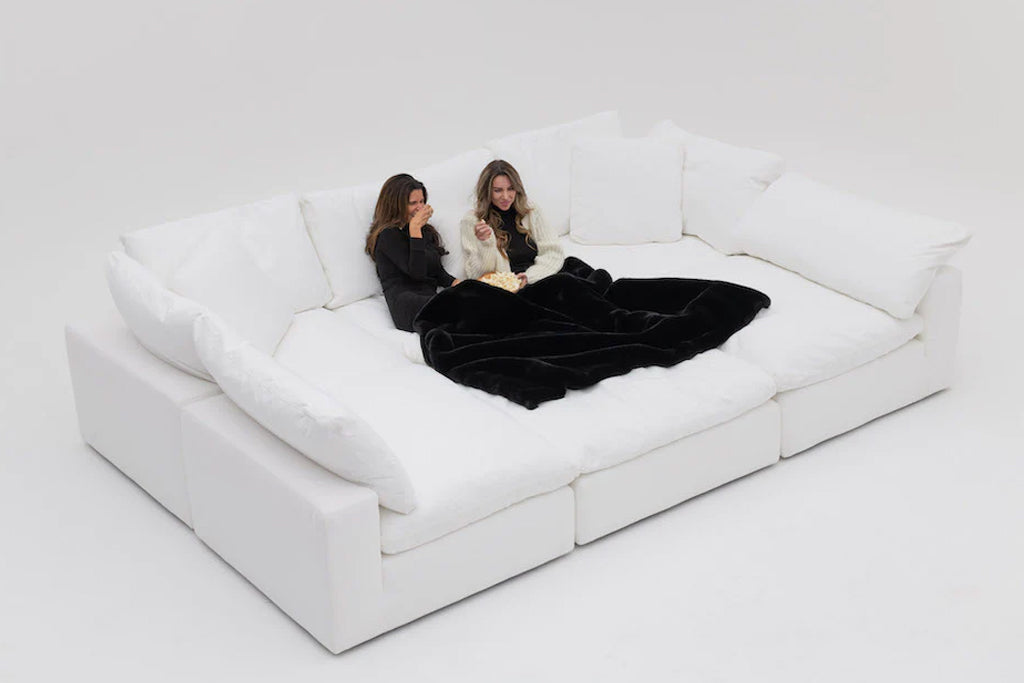
- 6 Cube Modular Sectional Couch or Movie Pit for larger homes and open living areas
FAQs
What is the Healthiest Couch to Buy?
The healthiest couch is usually the one with the clearest materials disclosure. Look for PFAS-free upholstery, no added flame retardants, lower-emission construction, OEKO-TEX fabrics, solid wood construction, and either natural fibers, fills, or foam that meet a recognized standard like CertiPUR-US.
Is a PFAS-Free Couch the Same as a Non-Toxic Couch?
No. A PFAS-free couch only tells you that the upholstery or treatment doesn't rely on PFAS chemistry. A broader non-toxic couch standard also looks at off-gassing, flame retardants, and formaldehyde-related construction concerns.
Do Couches Still Contain Flame Retardants?
Some conventional couches do, and some don't. California TB117-2013 doesn't require chemical flame retardants, so the only safe move is to verify the brand's disclosure rather than assuming. If a brand clearly states that it contains no added flame retardants, that is much stronger than a generic compliance label.
Is Memory Foam Toxic?
Not all memory foam is the same. The better question is whether the foam is disclosed, screened, and part of a broader low-emission build. Some memory foam products, like Soulfa's, meet CertiPUR-US standards, which is a helpful baseline.
Does Off-Gassing From a New Couch Go Away?
Usually, it decreases over time, especially in the first few months to years. The smarter move is to reduce risk before purchase by choosing lower-emission materials and more transparent brands. Open windows, run fans, and let the room air out after delivery. If a new couch has a strong chemical smell that lingers for a long time, that's definitely not a great sign.
Are Washable Covers Better For a Non-Toxic Couch?
Yes, from a practical standpoint. Washable covers make it easier to manage spills, dust, and daily wear without relying on harsh cleaners or replacing the whole couch. They don't make a couch non-toxic on their own, but they support a cleaner long-term maintenance routine.
Is An Organic Couch Worth the Cost?
Sometimes, yes, but not every buyer needs a fully organic couch. Many people do very well with a safer hybrid couch that removes the biggest red flags and offers stronger transparency. If your goal is a healthier home without giving up comfort, durability, or appearance, that middle path is often the smartest value.
Conclusion
The safest couch is not about one buzzword. Start by avoiding PFAS and added flame retardants. Look closely at foam, adhesives, finishes, and frame materials. Favor transparent construction, lower-emission choices, and a design built to last. That's how you find a non-toxic couch that actually fits real life, not just a marketing headline.
For many shoppers, that also means rejecting the false choice between a healthier home and a couch that feels soft, luxurious, and worth keeping. You should be able to have both.
If Soulfa is on your shortlist, compare the layouts that fit your space, review the 4 Cube Sectional or 6 Cube movie pit, and request fabric swatches before you decide. A better couch is one you can live with for years – comfortably, confidently, and without second-guessing what is in it.